
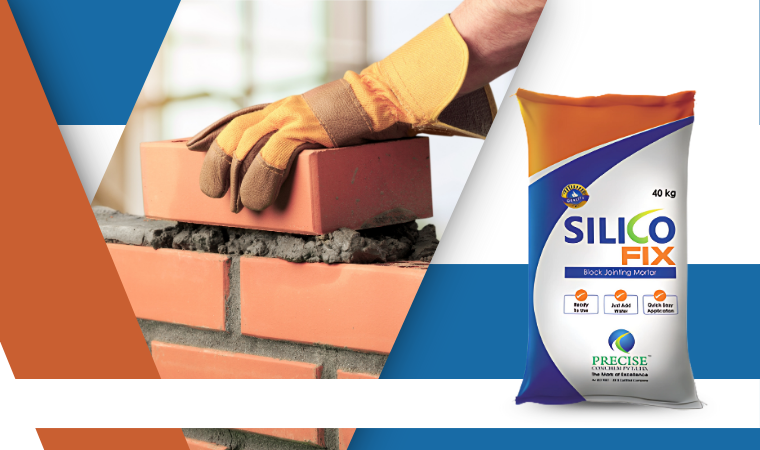
When constructing with AAC blocks, the biggest priorities for contractors and builders are speed, strength, alignment, and long-term durability. Traditional cement-sand mortar fails to meet these expectations, which is why modern sites across India have shifted to Block Jointing Mortar — a ready-to-use, polymer-modified mortar designed specifically for AAC lightweight blocks.
If you want cleaner construction, faster brickwork, and reduced material wastage, AAC Block Jointing Mortar is the best solution.
Why Builders Prefer Block Jointing Mortar Over Cement-Sand Mix
Traditional mortar requires large quantities, uneven mixing, excessive curing, and thick joints (10–12 mm), which creates cracks, weak bonding, and higher maintenance in the long run.
In comparison, Block Jointing Mortar offers:
✓ Thin 2–3 mm joint thickness
✓ Superior bonding strength
✓ Zero curing requirement
✓ Faster wall construction
✓ Cleaner, dust-free worksite
This results in stronger walls, reduced labour effort, and smooth, uniform masonry.
What Is AAC Block Jointing Mortar?
AAC Block Jointing Mortar is a factory-prepared dry mix designed for:
- AAC lightweight blocks
- Concrete blocks
- Fly ash bricks
- Cellular concrete blocks
Just add water, mix, and apply — no sand, no measuring, no batching. Every bag is consistent in quality, ensuring predictable performance on-site.
Benefits of Using Block Jointing Mortar (Contractor-Focused)
1. Faster Construction Speed
With its thin-bed application and easy mixability, masons complete wallwork nearly 3× faster compared to cement-sand mortar.
2. Higher Wall Strength
The polymer-modified formula gives excellent adhesion, reducing cracks, hollow joints, and seepage issues.
3. Reduced Block Jointing Mortar Consumption
Because joints are only 2–3 mm thick, contractors use much less material, lowering overall project cost.
4. No Curing Required
This saves water, labour, and time — especially helpful for high-rise and large commercial projects.
5. Perfect Alignment & Finish
Thin joints maintain uniformity across all rows of AAC blocks, creating:
- Straight walls
- Better finish
- Improved thermal efficiency
6. Better Water Resistance
Thin, compact joints prevent water from seeping through, making walls long-lasting and stronger.
Understanding Block Jointing Mortar Price
When comparing the AAC Block Jointing Mortar Price to traditional mortar, it may look slightly higher per bag, but contractors save significantly because:
- Less material required
- Faster work = lower labour cost
- No sand, sieving, or on-site mixing
- No curing cost
- Reduced wastage
This makes the Block Jointing Mortar Price extremely cost-effective in real-world applications.
Where Is Block Jointing Mortar Used?
It is ideal for:
- AAC block masonry
- Internal & external walls
- High-rise walls
- Partition walls
- Load-bearing AAC structures
- Commercial & industrial buildings
Wherever AAC blocks are used, Block Jointing Mortar delivers the best performance.
Conclusion
For builders looking to upgrade construction quality while reducing cost and time, Block Jointing Mortar for AAC Lightweight Blocks is the smartest choice. With improved bonding, thin joints, faster application, and economical consumption, it outperforms traditional mortar in every aspect.
If you want stronger walls, reliable alignment, and long-term durability, AAC Block Jointing Mortar gives the best results with maximum efficiency.